How to Clean a Shark Vacuum Filter (Foam, Felt & HEPA, Step by Step)
If your Shark vacuum’s suction has dropped, the filters are almost always the first thing worth checking — and most Shark models actually have two separate filters, not one. Most people only clean the one they can see. The good news: cleaning both takes a few minutes and no tools, once you know where to look and how long to let them dry.
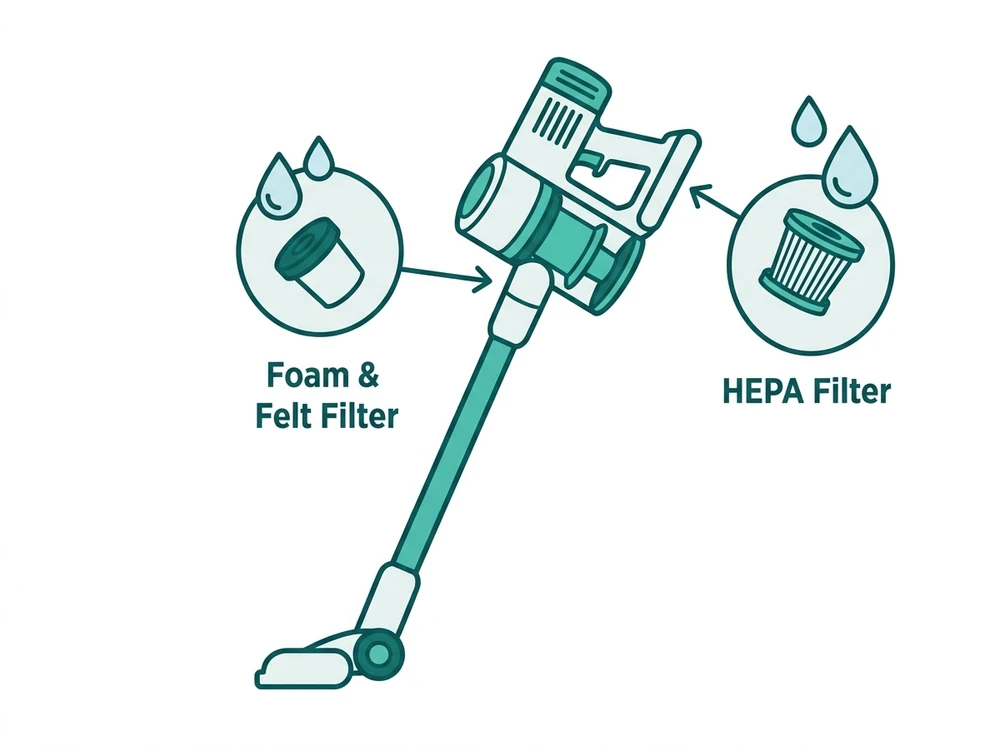
Identify Your Shark’s Filters
Most Shark vacuums use two filter types, and not every model has both, so check your dust cup area and exhaust vent before assuming you’re missing one:
- Pre-motor filters (foam and felt): Positioned before the motor to trap fine dust, usually located just below or behind the dust cup.
- Post-motor (HEPA) filter: Located after the motor, behind an exhaust vent cover on the main body, catching whatever the pre-motor filters missed.
Step 1: Remove and Tap Off Loose Dust
Open the filter housing and pull the filters out. Before introducing any water, hold each filter over a trash bin and tap it gently to knock loose dust and debris free — this keeps the bulk of the dirt out of your sink and makes the rinse step faster.
Step 2: Wash With Water Only
Foam and felt filters: Rinse under lukewarm running water. Do not use soap or detergents — they can degrade the foam and felt material. Gently squeeze the foam filter while rinsing to release trapped dirt, and stop once the water runs clear. Don’t scrub aggressively, and don’t put filters in a washing machine.
Post-motor (HEPA) filter: Rinse under running water, letting the water run through the dirty side to push particles out. Avoid twisting or wringing this filter — it’s more fragile than the foam/felt pair.
Step 3: Air Dry for 24 Hours, Then Reassemble
Shake off excess water and leave all filters in a warm, dry area to air-dry completely — this typically takes at least 24 hours. Do not use a tumble dryer or place filters on a radiator or other direct heat source. Never refit a damp or wet filter: moisture reaching the motor can cause severe, irreversible damage. Once every filter is 100% dry, place the felt filter in first (if your model has one), followed by the foam filter, then close the housing until it clicks securely.
How Often Should You Clean It?
Most Shark models call for cleaning the pre-motor foam and felt filters roughly monthly under normal use, per the manufacturer’s own care instructions — the post-motor HEPA filter needs it far less often, typically every several months to a year. If you’ve cleaned and fully dried both filters and suction still hasn’t recovered, the filter itself may simply be worn out rather than dirty.
If washing doesn’t bring your suction back, the filter may be past its usable life rather than just dirty. Check your model against our Shark vacuum filter compatibility guide to find a verified-fit replacement.
- Shark Vacuum No Suction? (Most Likely Causes, in Order) — if cleaning the filter didn’t fix weak suction, this is the next troubleshooting step
- Shark XFF350 / XHF350 HEPA Filter Compatibility Finder — find the exact replacement once cleaning no longer restores performance
Frequently Asked Questions
Can you wash a Shark vacuum filter with soap?
No. Use water only on every Shark filter type. Soap and detergents degrade the foam and felt material over time and can leave a residue that restricts airflow, which produces exactly the weak suction you were trying to fix. For the foam and felt pre-motor filters, rinse under lukewarm running water and squeeze the foam gently while rinsing to release trapped dirt, stopping once the water runs clear. Do not scrub aggressively and never put filters through a washing machine. The post-motor HEPA filter is more fragile and needs a gentler approach: run water through the dirty side so particles are pushed out rather than driven deeper, and avoid twisting or wringing it. Tapping each filter over a bin before it touches water removes most of the loose dust and makes the rinse quicker and less messy.
How long does a Shark vacuum filter take to dry?
At least 24 hours of air-drying, and that figure is a minimum rather than an estimate to work around. Shake off the excess water and leave every filter in a warm, dry area with good air circulation. Do not try to speed this up with a tumble dryer, hair dryer, radiator, or any other direct heat source, because heat can warp or shrink the foam and felt and damage HEPA media, permanently reducing how well the filter seals and filters. The reason the wait matters so much is what happens if you cut it short: moisture carried into the motor can cause severe and irreversible damage. If your vacuum is your only one and you need it sooner, a second set of filters is the practical answer, because there is no safe way to shorten the drying time itself.
What happens if I put a damp filter back in?
Moisture that reaches the motor can cause severe, irreversible damage, which is the single most expensive mistake in this whole process and the reason the drying step is not optional. A filter can feel dry on the surface while still holding water deep in the foam or felt, so surface touch is not a reliable test. Give every filter the full 24 hours of air-drying and confirm it is completely dry before it goes anywhere near the housing. This risk is also why heat shortcuts are a false economy: a tumble dryer or radiator may dry the filter faster but can distort the media, leaving a filter that no longer seals properly and lets unfiltered air past. If you are unsure whether a filter is fully dry, leave it longer. Waiting costs nothing; a damaged motor usually means a new vacuum.
How often should I clean my Shark vacuum filter?
Roughly monthly for the foam and felt pre-motor filters under normal household use, which is what the manufacturer care instructions call for. The post-motor HEPA filter needs attention far less often, typically somewhere between every several months and once a year, because it only handles what the pre-motor filters have already missed. Treat those intervals as a baseline rather than a rule: a home with pets, heavy carpet, or frequent vacuuming will clog filters faster and benefit from a shorter cycle, while light use can stretch it. The more useful signal is suction itself. A gradual drop-off between cleans is the filters telling you the interval is too long for how you actually use the vacuum. If you have cleaned and fully dried both filters and suction still has not recovered, the filter is likely worn rather than dirty.
Does cleaning the filter always fix low suction?
Not always. Cleaning resolves the most common cause, but it only helps if a dirty filter was the problem in the first place. If suction is still weak after a complete clean-and-dry cycle, there are two likely explanations. The filter may be worn out rather than dirty, since foam and felt degrade over repeated wash cycles and a filter past its usable life will not recover however carefully it is washed. Or the cause sits elsewhere in the airflow path: a dust cup filled past the Max Fill line, a bottom door that has not sealed, or a blockage in the hose, wand, or floor head. A quick way to separate these is to detach the wand and test suction directly at the handle, which tells you whether the restriction is upstream or downstream before you buy anything.
Source: SharkNinja official blog — how to clean your Shark vacuum filters, corroborated by SharkNinja’s AZ3000/UV3900/CH701/WV400 series filter-care support articles.