Big Blue Filter: 10-Inch vs. 20-Inch Housing Size Guide
If a “Big Blue” cartridge you bought doesn’t fit your housing, the mismatch is almost always length (10″ vs. 20″), not diameter — both standard sizes use the same 4.5″ body. Once you know which dimension actually varies, picking the right cartridge is a one-minute check.
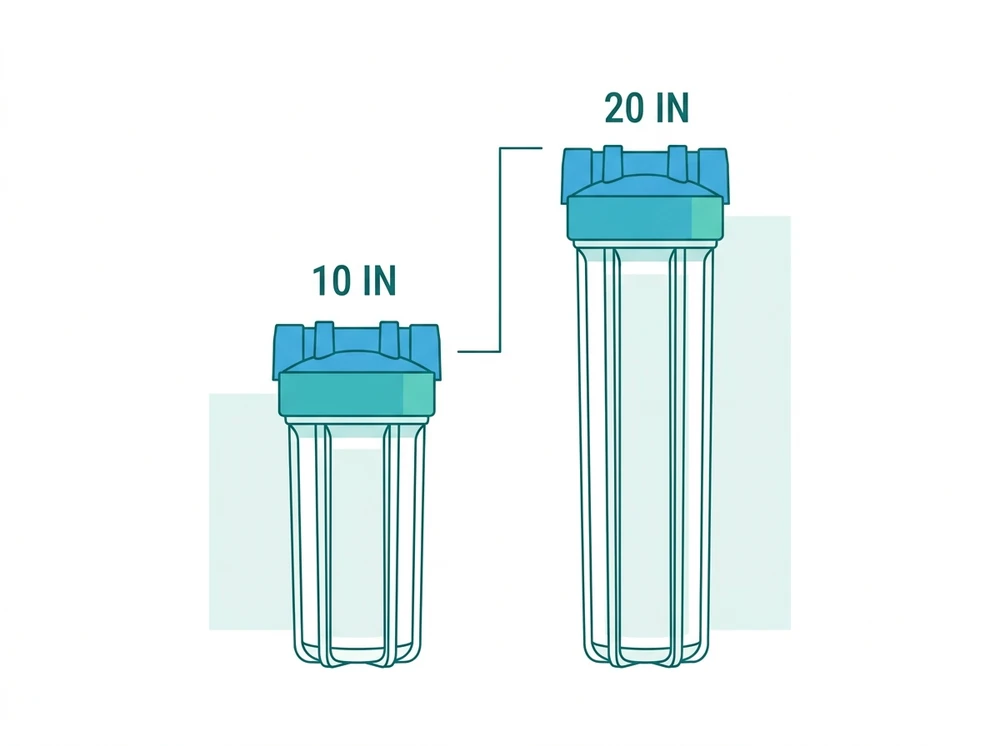
Step 1: Identify Your Housing Length
Measure the housing itself, not just the old cartridge, which may be worn or slightly compressed after months of use. Big Blue housings come in two standard lengths: 10″ and 20″. A 10″ housing takes a 10″ cartridge; a 20″ housing takes a 20″ cartridge — length is the variable that has to match exactly, and there’s no “close enough” here since the cartridge either seats fully in the sump or it doesn’t.
Step 2: Confirm Diameter Matches Too
Both standard Big Blue housings share the same 4.5″ diameter, so diameter usually isn’t the mismatch risk. That said, off-brand or non-standard housings do exist — don’t assume diameter automatically, especially if your housing came with a generic or unbranded system rather than a recognized “Big Blue” branded unit from Pentek, 3M, or a similar major manufacturer.
Step 3: Why the Two Lengths Exist
The 20″ housing isn’t just “bigger for no reason” — it roughly doubles the cartridge’s surface area compared to the 10″ version, which extends the time between cartridge changes and handles higher sediment loads better. As a rough guide: 10″ housings are adequate for smaller homes with low-to-moderate sediment, while 20″ housings are recommended for homes with 3+ bathrooms, heavy sediment, or additional treatment stages downstream that need more consistent flow. If you’re on well water with visible sediment or you’re changing a 10″ cartridge more often than the manufacturer’s stated interval, that’s usually the sign it’s time to consider the larger housing rather than just swapping cartridges more frequently.
Step 4: Check Your Clearance Before Upgrading
The 20″ housing’s real installed footprint is bigger than the filter length alone suggests — the full assembly with sump and cap runs roughly 7″x7″x21″. If you’re considering an upgrade from a 10″ to a 20″ system, confirm you actually have that clearance in your utility space before buying, including enough room below the housing to fully unscrew the sump for cartridge changes — a common install mistake is measuring only the housing’s static height and forgetting the extra drop clearance needed for maintenance.
Confirm your exact housing length and cartridge micron rating on the Whole House Water Filter Cartridge Sizes & Types Guide.
- Nominal vs. Actual Filter Size: Why It Won’t Fit — the sizing confusion a length/diameter mismatch often traces back to
- Water Filters — Whole House & Under Sink Guides — find the exact compatible cartridge for your system
Frequently Asked Questions
Do 10″ and 20″ Big Blue cartridges have different diameters?
No. Both standard sizes share the same 4.5-inch diameter, so diameter is almost never the reason a cartridge will not fit. Length is the dimension that actually varies, and it has to match exactly: a 10-inch housing takes a 10-inch cartridge and a 20-inch housing takes a 20-inch one. There is no close enough here, because the cartridge either seats fully in the sump or it does not. That is why a mismatch almost always turns out to be length rather than width, even though people tend to suspect diameter first. The one caveat is off-brand or non-standard housings, which do exist and do not always follow the 4.5-inch convention. If your system came as a generic or unbranded unit rather than a recognized Big Blue housing from Pentek, 3M, or a similar major manufacturer, measure the diameter rather than assuming it.
Should I upgrade from a 10″ to a 20″ housing?
It is worth considering if you have three or more bathrooms, heavy sediment in your supply, or additional treatment stages downstream that need consistent flow. Going to the 20-inch housing roughly doubles the cartridge surface area, which stretches the interval between changes and copes better with high sediment loads rather than simply filtering more finely. For a smaller home with low to moderate sediment, the 10-inch housing is genuinely adequate and the upgrade buys you little. The practical constraint is physical space, and it is the step people skip. Confirm you have roughly 21 inches of clearance below the mounting point before ordering, since you need room to drop the sump down and lift the cartridge out at change time, not just room for the housing to hang. Measure that clearance before you buy anything.
Why did my new cartridge feel different from the one I removed?
If the new cartridge carries the same nominal length and diameter, slight differences in feel are usually just normal manufacturing variation between batches or brands rather than a sign you have the wrong size. Filter media density, end-cap thickness, and how tightly the pleats or wrap are wound all vary a little between manufacturers, so two correctly sized cartridges can seat with noticeably different resistance. There is also a comparison problem worth keeping in mind: the cartridge you removed has been compressed and saturated for months, so it will not feel like a new one even if both are identical products. Judge fit by whether the cartridge seats fully and the housing closes and seals properly, not by how it feels in your hand. If it seats and seals, the size is right. A cartridge that will not seat fully, by contrast, is a length problem and no amount of pressure will correct it.
Can I mix a Pentek cartridge with a generic Big Blue housing, or vice versa?
Generally yes. Both follow the same industry convention of a 4.5-inch diameter with 10-inch and 20-inch lengths, which is precisely what makes the Big Blue format useful, so cartridges and housings from different manufacturers normally interchange without trouble. The exception is unbranded or older housings, which do not always respect the standard and can differ enough to prevent a proper seal even when the cartridge physically drops in. If your housing is generic, second-hand, or old enough that you cannot identify the maker, measure the sump depth and internal diameter before ordering rather than trusting the label. It is also worth checking that the cartridge end caps match the style your housing expects, since a double open end and a closed end are not interchangeable even at identical dimensions. A quick photo of your old cartridge and housing label before you throw anything away saves guessing at any of this next time.
Sources: Fresh Water Systems — Big Blue filter housing guide, Mid Atlantic Water — 10 vs. 20 inch guide.