Whole House Water Filter Cartridge Sizes & Types — Which One Do You Need?
Whole house filter housings almost always take one of two standard cartridge lengths, but the media inside — sediment, carbon, or both — is a separate choice that trips up just as many people. Get either one wrong and you’ll either buy a cartridge that doesn’t fit your housing, or one that fits fine but doesn’t filter the thing you actually needed filtered. This guide covers both: how to identify your cartridge size, and how to pick the right media type.
Already know your housing brand? Check our GE, Culligan & American Plumber compatibility guide → for a verified match instead of guessing from the chart below.
How Do You Tell Your Cartridge Size?
Measure the cartridge’s length and diameter directly, or check the model number printed on your existing housing against the size chart below.
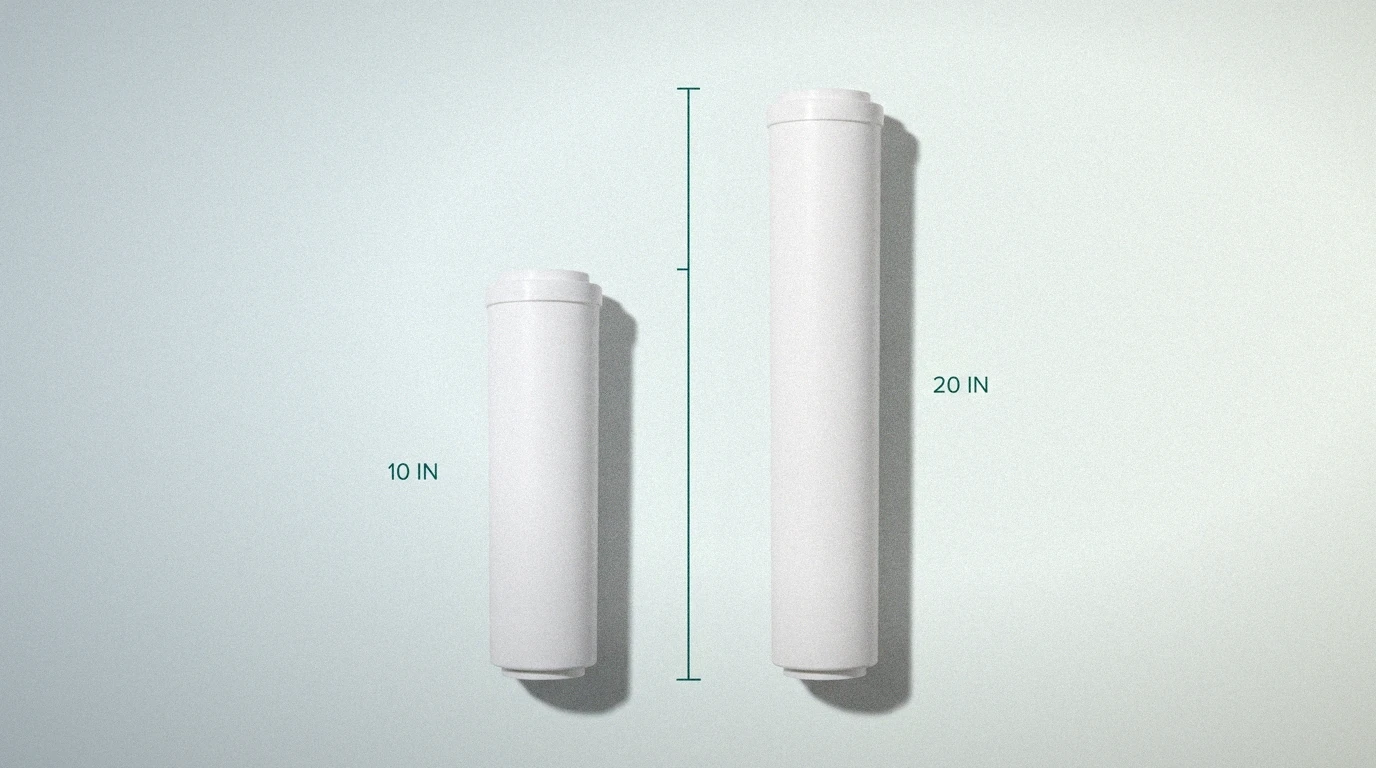
Whole house cartridges are sold by two measurements: length and diameter. Diameter is almost always 4.5 inches for standard residential systems — length is where the real split happens. Measure your existing cartridge (or the empty housing) end to end. A cartridge around 9.75 inches is a “10-inch” nominal system; one around 19.75 inches is a “20-inch” nominal system, sometimes labeled “Big Blue.” The nominal number is always rounded up slightly from the actual measurement, same as HVAC filter sizing.
Whole House Filter Cartridge Size Chart
| Nominal Size | Actual Length | Common Housing Brands | Find a Match |
|---|---|---|---|
| 10″ x 4.5″ | ~9.75″ x 4.5″ | GE GXWH40L/GXWH35F, Culligan RFC-BBSA, American Plumber W10-PR/W10-BC/WRC25HD | Check verified match → |
| 20″ x 4.5″ (“Big Blue”) | ~19.75″ x 4.5″ | High-capacity and well-water systems, larger households | Not yet in our verified tool |
If your cartridge doesn’t match either length, measure it directly rather than assuming — a handful of systems use non-standard housings, and a cartridge that’s even half an inch off either won’t seat properly or will leave a gap that lets unfiltered water bypass the media entirely.
Sediment vs. Carbon vs. Carbon+KDF: Which Media Do You Need?
- Sediment-only — a pleated or spun polypropylene cartridge that removes dirt, rust, and sand. It does nothing for chlorine taste or odor. Use it as a first-stage filter ahead of a carbon cartridge, or on its own if particulate is your only issue (common on well water).
- Carbon block — removes chlorine taste and odor plus some chemicals, but doesn’t handle heavy sediment well since it clogs faster with particulate load. This is the standard choice for municipal (city) water, which is usually already low in sediment.
- Carbon + KDF — adds heavy metal reduction (lead, mercury) and bacteriostatic properties on top of standard carbon block’s taste/odor removal. Costs more, worth it if your water report flags heavy metals.
Many whole house systems run two housings in sequence — a sediment pre-filter followed by a carbon or carbon+KDF cartridge — rather than trying to do both jobs with one cartridge. If your system only has a single housing, match the media to your actual water quality issue rather than defaulting to whichever cartridge is cheapest.
How Often to Replace Your Whole House Filter
Carbon and carbon+KDF cartridges typically last 3 to 6 months for average residential use. Sediment cartridges vary more — every 1 to 3 months on well water with heavy particulate, up to 6 months on cleaner municipal water. Watch for two signs regardless of the schedule: dropping water pressure (the cartridge is clogged with sediment) or the return of chlorine taste or odor (the carbon is exhausted, even if the cartridge still looks fine).
Find Your Verified Match
Know your housing brand? Our GE, Culligan & American Plumber whole house guide cross-references manufacturer specs and retailer data for a confirmed replacement — not just a similar-looking part number.
Cartridge does not fit your Big Blue housing? See 10-inch vs. 20-inch housing sizing explained →
Frequently Asked Questions
What’s the difference between a 10-inch and 20-inch whole house filter?
Length and capacity, not filtering ability. Both standard sizes share the same 4.5-inch diameter, so the only dimension that changes is length: roughly 9.75 inches actual for a 10-inch nominal system, and roughly 19.75 inches for a 20-inch nominal one, often sold as Big Blue. The 20-inch cartridge holds around twice the filtration media, which means it lasts longer between changes and copes better with heavy sediment loads. It does not filter more finely; micron rating is a separate specification from size. Choose the 20-inch format if you have three or more bathrooms, high sediment, or additional treatment stages downstream that need steady flow. For a smaller home with moderate sediment, the 10-inch system is genuinely sufficient. Whichever you pick, the cartridge length must match the housing exactly, since it either seats fully or it does not.
Do I need a sediment filter, a carbon filter, or both?
It depends on what is actually in your water, and the two media types solve different problems. Choose a sediment cartridge if you see visible dirt, rust, sand, or general cloudiness, since its job is to trap physical particles. Choose carbon if the issue is chlorine taste or odor, or other dissolved compounds that affect how the water tastes and smells, because carbon works by adsorption rather than by straining. Many homes genuinely need both, which is what dual-stage systems exist for. The mistake worth avoiding is buying on media type alone without matching it to a symptom: a carbon cartridge will do nothing about visible grit, and a sediment cartridge will not improve chlorine taste. Identify the problem first, then pick the media, then confirm the cartridge size fits your housing, since media type and cartridge size are chosen independently of each other.
How do I know what size cartridge my housing takes?
Measure your existing cartridge end to end, or check the housing itself for a stamped model number. Measuring is the more reliable route because model numbers are often worn or hidden once a system is installed. A cartridge measuring around 9.75 inches belongs to a 10-inch nominal system; one around 19.75 inches belongs to a 20-inch system. Diameter is almost always 4.5 inches on standard residential units, so length is where the real split happens. Round your measurement up to the nearest standard nominal size when ordering, since nominal is always slightly larger than actual, exactly as it is with HVAC filter sizing. If your housing is a recognized brand such as GE, Culligan, or American Plumber, checking the model against a verified compatibility guide is faster and safer than measuring alone. Photograph the housing label before installing a new cartridge so you never have to measure again.
Can I mix sediment and carbon cartridges in a dual-stage system?
Yes, and that is precisely how dual-stage systems are designed to work. The order matters, though, and getting it backward wastes the more expensive cartridge. Install the sediment cartridge in the first housing, the one closest to where water enters your home, and the carbon cartridge in the second. That sequence lets the sediment stage remove grit, rust, and particles first, so the carbon stage receives already-clear water and can spend its capacity on taste and odor rather than clogging with debris. Reversing them shortens carbon life considerably for no benefit. Both cartridges must share the same nominal size as their housings, since a dual-stage system uses two separate housings that each have their own size requirement. Check both rather than assuming they match each other. In practice they usually do match, but confirming costs nothing and a mismatch is only discovered once the wrong cartridge is already in your hands.
Other Filter Tools
Also need a filter match for something else?
Every match on this page is cross-referenced against manufacturer specs and retailer data — not just similar-looking part numbers. How we verify compatibility →
Looking for a different filter?
Fridge Filters · HVAC Filters · Vacuum Filters · Water Filtration