How Often to Change a Furnace Filter (By Thickness, Type & Household Factors)
Most furnace filters need replacing every 1 to 3 months, but the real answer depends on the filter’s thickness. A thin 1-inch filter clogs far faster than a 4-inch media filter, and pets, allergies, and how hard your furnace is working all shift that window. Here’s the schedule broken down by type, plus how to tell your filter needs changing right now.
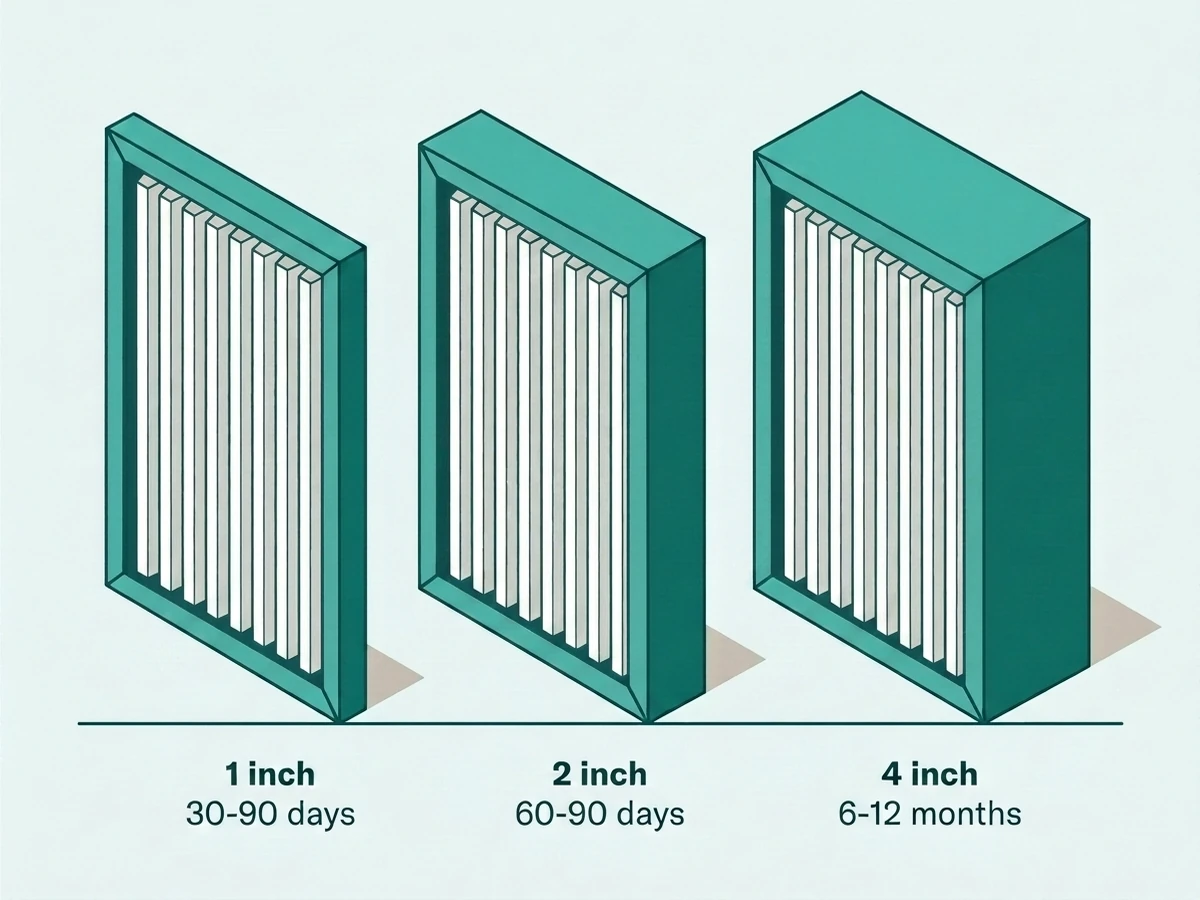
Furnace Filter Replacement Interval by Thickness & Type
Thicker filters have more surface area to trap dust before airflow suffers, so they last longer between changes. Use this table as your starting point, then adjust with the factors below.
| Filter Thickness | Typical Material | Replace Every | MERV Range |
|---|---|---|---|
| 1 inch | Fiberglass or pleated | 30-90 days | 4-13 |
| 2 inch | Pleated | 60-90 days | 8-13 |
| 4-5 inch | Media (pleated, deep) | 6-12 months | 8-16 |
Fiberglass 1-inch filters sit at the low end of that range since they’re built to trap large particles cheaply, not to last. A pleated 1-inch filter with a higher MERV rating holds more dust before it needs replacing, but still won’t approach the interval a 4- or 5-inch media filter gets from its much larger surface area.
When to Change It Sooner
The table above assumes an average household. Several common factors shrink that window:
- Pets in the home. Shedding adds a steady load of hair and dander that clogs a filter faster than dust alone. Check monthly if you have a dog or cat, even with a 1-inch filter rated for 90 days.
- Allergies or asthma in the household. A filter that’s technically still working can still be under-filtering fine particles once it’s partially loaded. Change on the shorter end of the range, or move up to a higher MERV filter if your furnace can handle the added airflow resistance.
- Heavy use during peak season. A furnace running most of the day during a cold snap pulls far more air through the filter than one cycling occasionally in mild weather, which shortens the real-world interval regardless of the calendar.
- Recent renovation or construction dust. Drywall dust and sawdust load a filter within days, not months. Check weekly during and after any home renovation work.
- Visual check. Hold the filter up to a light. If you can’t see light through it, replace it regardless of how long it’s been installed.
Seasonal Guide
Furnace filter demand isn’t constant across the year, and the interval should flex with it.
Fall (start of heating season): Install a fresh filter before the first cold snap, even if the current one technically has weeks left. This gives you a clean baseline heading into the season’s heaviest use.
Winter: Check monthly. This is peak load for most furnaces, and a 1-inch filter can saturate closer to the 30-day end of its range during a stretch of continuous heating.
Spring: As heating demand drops, intervals can stretch back toward the longer end of the range, but don’t skip the check entirely if central air runs through the same ductwork and filter.
Summer: If your furnace’s blower also handles air conditioning, the filter is still working even though the furnace itself isn’t heating. Keep checking on the same schedule rather than assuming the “off season” means no maintenance.
How to Tell Your Filter Needs Changing Right Now
Skip the calendar and check the filter itself if you notice any of these:
- Visible gray dust buildup covering the pleats or surface
- Weaker airflow from vents throughout the house
- The furnace running longer cycles than usual to reach the thermostat setting
- A noticeable rise in your heating bill with no other explanation
- Dust settling faster than usual on furniture near vents
Any one of these is a sign to check the filter immediately, even if you’re still within the typical interval for its thickness.
Due for a change? Read the size printed on the old filter’s frame first (our air filter size chart explains nominal vs actual size). For the four most common sizes:
16x25x1 · 14x20x1 at Air Filters Delivered · 20x25x1 · 16x20x1 at Factory Direct Filters. Other sizes: use the HVAC filter finder. (Affiliate links: we may earn a commission at no cost to you.)
What Happens If You Don’t Change It
A clogged filter restricts airflow through the whole system, not just at the filter itself. The blower motor has to work harder to pull air through, which raises energy use and heating bills. Reduced airflow also means less heat exchange efficiency, so rooms take longer to warm up even as the furnace runs more. Left long enough, a badly clogged filter can cause the system to overheat and shut down on its own safety cutoff, or in more serious cases contribute to premature wear on the blower motor and heat exchanger. None of this requires a dramatically overdue filter. It builds gradually, which is exactly why a fixed check-in schedule catches it before it becomes a bigger repair.
Know it’s time to change your filter? Make sure you buy the right size. Use our furnace filter finder to check your exact dimensions and MERV options, or see the full air filter size chart if you already know your measurements.
Frequently Asked Questions
How can I tell if my furnace filter needs changing?
Hold it up to a light source. If you cannot see light passing through it, or the surface is visibly caked in gray dust, replace it regardless of how long it has been installed. That single test beats the calendar, because actual load varies far more than any published interval suggests. Several other signs point the same way: weaker airflow from vents throughout the house, the furnace running longer cycles than usual to reach the thermostat setting, a rise in your heating bill with no other explanation, and dust settling faster than normal on furniture near vents. Any one of those is reason to check the filter immediately even if you are still inside the typical interval for its thickness. Treat the interval as a reminder to look, not as permission to wait, since a filter that has loaded early gives you these signals long before its rated date arrives.
How often should you replace your furnace filter in winter?
Every 30 to 60 days through peak heating season, which is shorter than the same filter would need in milder months. The reason is load rather than time: a furnace running most of the day during a cold snap pulls far more air through the filter than one cycling occasionally in mild weather, so a 1-inch filter rated for 90 days can saturate closer to the 30-day end of its range. Check monthly through winter rather than waiting for a date. It also helps to start the season right by installing a fresh filter before the first cold snap, even if the current one technically has weeks left, since that gives you a clean baseline heading into the heaviest use of the year and makes the monthly checks easier to judge against. If your blower also handles air conditioning, keep the same schedule year round, because the filter is still working even when the furnace is not heating.
How long does a 1-inch furnace filter last?
Typically 30 to 90 days, and where you land in that range depends mostly on the filter material and your household. Fiberglass 1-inch filters sit at the low end, because they are built to trap large particles cheaply rather than to last. A pleated 1-inch filter with a higher MERV rating holds more dust before it needs replacing, though it still will not approach what a 4- or 5-inch media filter manages from its much larger surface area. Shorten the interval if you have pets, since shedding adds a steady load of hair and dander, or if anyone in the home has allergies or asthma. Check monthly either way. During or after renovation work, check weekly, because drywall dust and sawdust load a filter within days rather than months. The light test settles it in either case: if you cannot see light through the filter, it is done regardless of what the packaging promised.
How often should you change a 16x25x1 furnace filter?
The same guidance applies as for any 1-inch filter: every 30 to 90 days, with a monthly visual check. The dimensions printed on the frame tell you what will physically fit your slot, not how long the filter lasts. Only the depth figure, the final number in the size, affects the interval, because depth determines how much filter media is packed into the frame and therefore how much dust it can hold before airflow suffers. A 16x25x1 and a 20x20x1 both being 1-inch filters will behave the same way on the same system. If you want a longer interval, the change that matters is moving to a thicker filter, which means confirming your furnace has a slot built for that depth. A thicker filter will not fit a slot sized for a thinner one.
Do thicker filters really last longer?
Yes, and the difference is substantial rather than marginal. A 4- or 5-inch media filter can go 6 to 12 months between changes, compared with 30 to 90 days for a 1-inch filter. The reason is surface area: a deeper filter packs far more media into the frame, so it holds much more dust before airflow starts to suffer. A 2-inch filter sits between the two at roughly 60 to 90 days. This is the single biggest lever on how often you deal with filters at all, but it is not a free upgrade. Your furnace has to have a filter slot built for that depth, since a thicker filter will not physically fit a thinner slot and forcing one in breaks the seal, letting air bypass the media entirely. Check your slot depth before switching.
Does a higher MERV rating mean less frequent changes?
Not necessarily, and assuming so is a common way to end up with restricted airflow. Higher-MERV filters trap more particles, including finer ones, but capturing more material also means they can clog faster under a heavy dust load, which works against the longer interval people expect. MERV describes how finely a filter filters, not how long it lasts; depth is what governs interval. There is a second consideration before moving up the scale: a higher-MERV filter adds airflow resistance, and not every furnace is rated to handle it, so a filter that is too restrictive for your system can reduce airflow even when it is perfectly clean. Follow the manufacturer’s rated interval for your specific filter rather than inferring one from the MERV number. If you want both finer filtration and a longer interval, the combination that actually delivers it is a higher-MERV filter in a thicker format, assuming your furnace has a slot deep enough to take one.
Worried a pleated filter will choke your airflow? See do pleated air filters restrict airflow for what the EPA and field studies found.
Sources: Carrier — how often to change an air filter and US EPA — Guide to Air Cleaners in the Home.
Related Filter Tools
Furnace filters are only one part of keeping your home’s air and water systems running right. Check compatible matches for your specific equipment:
- HVAC Filter Finder — find your exact size and MERV rating, cross-checked across retailers
- Furnace Filters Guide — filter types, MERV ratings, and sizing explained in one place
- Air Filter Size Chart — nominal vs. actual dimensions for every common size
- Refrigerator Water Filter Finder — match your fridge model to a verified replacement filter
- Vacuum Filter Finder — find compatible filters for major vacuum brands