Nominal vs. Actual Filter Size: Why It Won’t Fit
If your new filter feels loose, warped, or won’t sit flush in the slot even though the box says the same size as your old one, you’re not measuring wrong — nominal and actual size are two different numbers by design. Once you understand which number does what, picking the right filter takes seconds.
Step 1: Understand the Two Numbers
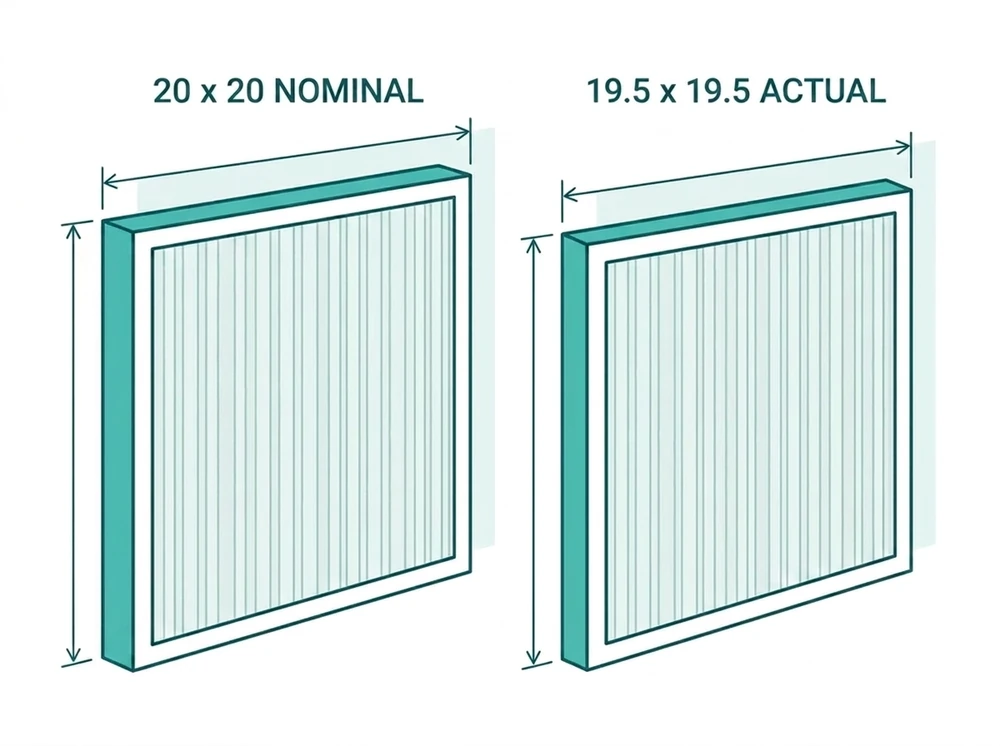
Nominal size is the rounded, standardized label printed on the filter frame — something like “20x20x1.” It’s an industry-standard rounded size used for ordering, not a precise measurement.
Actual size is the filter’s true, physical dimensions, and it’s always smaller than the nominal label — typically by 0.25″ to 0.5″ per side. A filter labeled 20x20x1 usually measures closer to 19.5″x19.5″x0.75″ in real life. This intentional undersizing is exactly what lets the filter slide into the housing without binding — a filter cut to the exact nominal dimensions wouldn’t physically fit most slots at all. Depth shrinks the same way — a “1-inch” filter is commonly closer to 3/4″ in actual thickness.
Step 2: How to Measure Correctly
Measure the slot or frame opening itself, not your old filter. Old filters can be worn, warped, or compressed, which gives you a misleading reading — a filter that’s been in place for months can measure noticeably smaller than it did new. Once you know the actual opening size, round up to the nearest standard nominal size when ordering — that’s the number manufacturers expect you to search and buy by. Ordering by a tape-measure reading of the slot’s exact actual dimensions, rather than the standard nominal size, is the single most common way people end up with a filter that doesn’t match anything sold.
Ready to order? Search by the nominal size printed on the frame, or the standard size you rounded up to after measuring the slot (our air filter size chart lists them all). For the four most common sizes:
16x25x1 · 14x20x1 at Air Filters Delivered · 20x25x1 · 16x20x1 at Factory Direct Filters. Other sizes: use the HVAC filter finder. (Affiliate links: we may earn a commission at no cost to you.)
Step 3: Why Brand-Switching Causes Fit Surprises
Actual dimensions aren’t standardized across brands even when the nominal size matches. A 20×25 nominal filter from one manufacturer can differ slightly in actual size from another brand’s 20×25 — which is why a filter that fit fine last time can suddenly feel a little loose or a little tight after switching brands, even with the identical printed size. That’s normal, not a sign you bought the wrong size. If the difference feels significant rather than marginal, it’s worth trying one more brand before assuming your slot is a non-standard size.
Step 4: What a “Close Enough” Fit Costs
A too-loose filter lets unfiltered air bypass around its edges, defeating the point of filtering at all — dust and allergens get pulled straight past the media through the gap. A too-tight filter can warp or crack the frame, or restrict airflow enough to strain the system’s blower motor over time. Get the nominal size right rather than forcing a near-miss to work in either direction.
Once you know your correct nominal size, cross-check it against exact actual dimensions and MERV rating options on the Air Filter Size Chart. If your thermostat is also flashing a filter reminder, see our guide on clearing a Honeywell replace-filter alert.
Frequently Asked Questions
Should I measure my old filter or the slot it goes in?
Always measure the slot or frame opening, never the old filter. A filter that has been in place for months is worn, warped, or compressed, so it measures noticeably smaller than it did new and gives you a reading that leads you straight to an undersized replacement. The opening does not change; the filter does. Once you have the true opening size, round up to the nearest standard nominal size when ordering, because nominal is the number manufacturers expect you to search and buy by. This is where most mistakes happen: people measure carefully, then order by the exact tape-measure reading rather than the standard nominal label, and receive something that does not correspond to any normal size. Measure the opening, round up to the standard size, and order by that number, and the fit will take care of itself.
Why does a filter with the same printed size fit differently between brands?
Because nominal sizes are standardized but actual dimensions are not. The label is an industry-standard rounded number used for ordering, while the true physical size sits below it, typically by a quarter to a half inch per side. Each manufacturer chooses its own undersizing within that range, so two filters both labeled 20×25 can differ slightly in real measurements and therefore seat differently in the same slot. Neither is defective and neither is mislabeled; they are simply expressing the same nominal size with different actual dimensions. This is worth knowing before assuming a brand got it wrong. If one brand consistently fits your housing better than another, that is a legitimate reason to stay with it, and it is why noting the brand that worked is more useful than noting the size alone. Keep a note of the brand and nominal size that fitted well, since that pair is what you actually want to reorder.
Is a slightly loose filter really a problem?
Yes, and it undermines the whole point of having a filter. Air follows the path of least resistance, so a gap around the edges lets unfiltered air bypass the media entirely rather than passing through it. The system keeps moving air and appears to work normally, while a share of that air is carrying dust straight past the filter and onward. A loose filter is therefore worse than an obviously wrong one, because nothing about it looks like a fault. Some clearance is intentional and correct, which is exactly why actual dimensions run smaller than nominal, but the filter should still sit flush in the slot without visible gaps or room to shift around. If yours rattles, slides, or leaves a visible gap along an edge, you have the wrong actual size for that opening.
Why is a “1-inch” filter actually about 3/4 inch thick?
Depth is a nominal number too, not just width and height, and it gets rounded the same way. A filter sold as 1 inch thick commonly measures closer to three quarters of an inch in reality, which is deliberate rather than a shortfall on the manufacturer’s part. The undersizing across every dimension is what lets a filter slide into its housing without binding; a filter cut to exact nominal dimensions would not physically fit most slots. The practical consequence is that you should order by the nominal depth printed on the frame, the same as with the other two dimensions, rather than measuring your old filter’s actual thickness and hunting for that number. Mixing nominal and actual figures across dimensions is the fastest route to a filter that does not fit. Read every number on the frame as nominal unless it explicitly says otherwise.
Sources: Filterbuy — air filter sizes chart, Nordic Pure — nominal vs. actual size guide.