Range Hood Filter Replacement Guide
Range hood filters aren’t sold under one universal part number the way some appliance filters are — but they’re also not as brand-locked as they look. Range hood grease filters are often interchangeable across brands once you know your filter type and dimensions, but dimensions alone don’t guarantee a fit. The frame profile, handle style, mounting tabs, and clip design also have to match your hood, or a filter with the right length and width can still sit loose, rattle, or fail to latch. FilterFitNow cross-references manufacturer specs and independent retailer sizing data before recommending a match, rather than guessing from a similar-looking part number.
Dimensions are the starting point, not the whole answer. Two filters can share the same length, width, and thickness and still not fit the same hood if the frame shape, handle/tab placement, or clip style is different. Always test-fit or compare frame and mounting details against your old filter, not just the size on the label, before assuming a replacement will work.
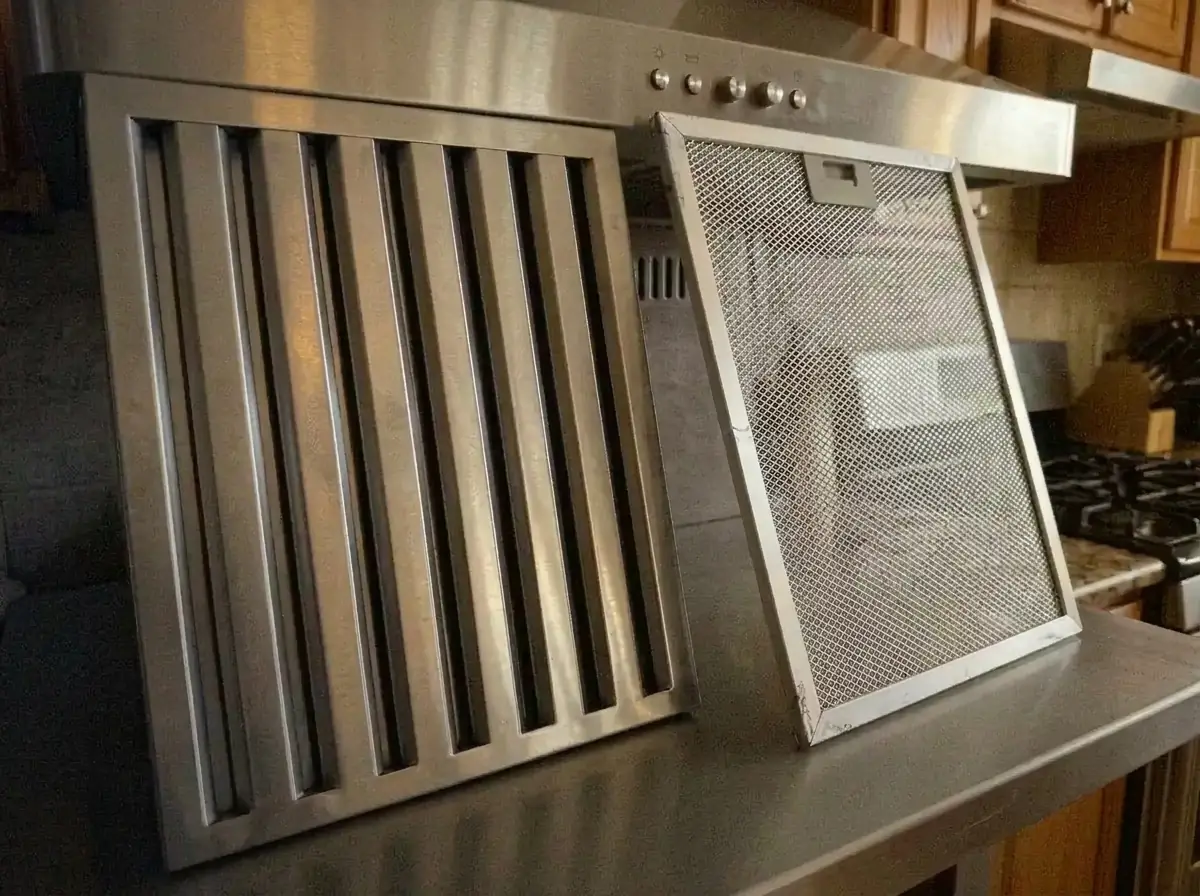
Vented hoods only need a grease filter — no charcoal filter to worry about.
Ductless hoods need both a grease filter and a charcoal filter working together.
Which Type of Range Hood Filter Do You Have?
Range hoods use two different filter types, and they are not interchangeable with each other:
| Filter Type | What It Does | Replace or Wash? |
|---|---|---|
| Grease filter (mesh or baffle, aluminum or stainless steel) | Traps grease and oil from cooking fumes before they reach the fan and ductwork | Washable — clean every 1–3 months, no replacement needed unless damaged |
| Charcoal / carbon filter | Absorbs odor and smoke — only used on ductless (recirculating) range hoods | Not washable — replace every 3–6 months |
If your range hood vents outside through ductwork, you likely only have a grease filter. If it recirculates air back into the kitchen (no external vent), you have both a grease filter and a charcoal filter working together.
How to Measure Your Filter for a Correct Replacement
For full step-by-step measuring instructions with photos-worth of detail on where exactly to measure, see the dedicated Range Hood Filter Sizes guide. The short version:
Grease filters typically run 10″–20″ wide by 12″–18″ long, depending on hood size. Charcoal filters vary more by shape: square filters commonly run 8″–12″ per side, round filters 6″–8″ in diameter, and solid block filters 10″–14″ wide by 5″–8″ thick. Remove your existing filter and measure it directly rather than relying on your range hood’s model number alone — the same hood model sometimes shipped with different filter sizes across production years.
Universal cut-to-fit charcoal filters exist specifically because of this variation — some are rated to trim down to fit openings as large as 15″ x 18″, covering well over 1,000 individual filter-size listings across brands. If your exact model isn’t listed anywhere, a cut-to-fit universal filter is a legitimate fallback, not a compromise.
Range Hood Filter Type Reference
Typical dimensions and care by filter type — measure your own filter to confirm before ordering.
| Type | Typical Size | Washable? | Replace Interval |
|---|---|---|---|
| Aluminum mesh grease | 10–20″ wide × 12–18″ long | Yes | Clean every 1–3 months |
| Stainless steel baffle grease | 10–20″ wide × 12–18″ long | Yes | Clean every 1–3 months |
| Square charcoal | 8–12″ per side (cut-to-fit up to 15×18″) | No | Replace every 3–6 months |
| Round charcoal | 6–8″ diameter | No | Replace every 3–6 months |
| Solid block charcoal | 10–14″ wide × 5–8″ thick | No | Replace every 3–6 months |
How We Verified This
- Manufacturer filter-type and sizing documentation from Broan-NuTone, Whirlpool, and other major range hood brands
- Independent retailer sizing charts cross-referencing grease and charcoal filter dimensions across brands
- Universal/cut-to-fit filter manufacturer specifications confirming cross-brand dimensional compatibility
Where sources disagreed on a specific compatibility claim, we didn’t include it. We also don’t publish brand-to-brand model cross-references we haven’t verified — unlike our fridge and water filter guides, no confirmed per-model compatibility data exists yet for range hood filters, so this guide uses type and dimension matching instead of guessing at model numbers. Read the full verification methodology →
How to Replace a Range Hood Filter
For the full walkthrough, including separate steps for charcoal filters, see the dedicated How to Replace a Range Hood Filter guide. The short version for a grease filter:
- Turn off the range hood and let it cool if it was recently in use.
- Locate the filter release — most grease filters slide out or unclip from the underside of the hood without tools.
- For a ductless hood, check behind or above the grease filter for the charcoal filter, which is usually held by a separate clip or twist-lock.
- Measure the old filter (or the opening it came from) before ordering a replacement.
- Install the new filter in the same orientation as the old one — grease filters are directional and only fit correctly one way.
- Grease filters: wash in warm soapy water or run through the dishwasher, dry fully, and reinstall. Charcoal filters: discard, they cannot be cleaned.
Frequently Asked Questions
Can I use a charcoal filter in place of a grease filter?
No. They serve different purposes and aren’t interchangeable, a charcoal filter won’t trap grease, and a grease filter won’t reduce odor the way a charcoal filter does. Grease filters work mechanically: a metal mesh or baffle design forces air to change direction repeatedly, so airborne grease droplets are physically caught by impaction on the metal surface. Charcoal filters work chemically instead, using activated carbon to adsorb odor molecules as air passes through, which is why they have no meaningful effect on grease and need periodic replacement rather than cleaning since spent carbon cannot be reactivated at home. A ducted range hood that vents outside doesn’t need a charcoal filter at all, since odors and grease-laden air both exit the home directly. Trying to substitute one for the other typically means either grease building up unchecked inside a ductless hood or paying for carbon replacement that does nothing for a vented one.
Do all range hoods need a charcoal filter?
No. Only ductless (recirculating) range hoods use one. If your hood vents outside through ductwork, you only need to maintain the grease filter. Ductless hoods pull air through the grease filter and then through a charcoal filter before recirculating the cleaned air back into the kitchen, since there is no duct to send it outside; the charcoal stage is what removes cooking odors before that air re-enters the room. Some hoods are sold as convertible, meaning they can be installed either way, and typically include a charcoal filter insert in the box that only needs to be installed if you are actually running the hood in ductless mode rather than venting it outdoors. Checking your hood’s installation manual or looking for actual ductwork running to the outside is the fastest way to confirm which mode yours is in if you’re not sure.
My range hood model isn’t listed anywhere — what do I do?
Measure your existing filter directly and look for a universal or cut-to-fit replacement in that size, rather than searching by model number alone. Range hood filters are far less standardized across brands than refrigerator or HVAC filters, and many manufacturers do not maintain an easily searchable model-to-filter lookup, which makes measuring the physical filter the most reliable identification method. Measure the length and width of the metal mesh or baffle panel itself, not the opening it sits in, since panels are often slightly smaller than the housing to allow for the mounting clips. Universal cut-to-fit aluminum mesh sheets, sized to be trimmed down, cover most common range hood dimensions when an exact pre-cut replacement isn’t available. Bringing the old filter’s measurements, rather than just a model name, to a hardware or appliance parts store is usually enough to find a correctly sized universal replacement on the spot.
Are range hood filters universal across brands?
Grease filters are largely interchangeable across brands when the dimensions match, since they’re a simple mesh or baffle design. Charcoal filters vary more by shape, but universal cut-to-fit options exist for most common sizes — see the type reference table above.
Do grease filters ever need to be replaced, or can they always be cleaned?
A well-maintained metal grease filter can usually be cleaned indefinitely. Replace it only if it’s visibly warped, the mesh has torn, or hardened grease buildup no longer comes out with cleaning.
Looking for a different filter?
Fridge Filters · HVAC Filters · Vacuum Filters · Water Filtration
FilterFitNow may earn a commission on purchases made through links on this page — it doesn’t affect which filter we recommend. See our full affiliate disclosure.