Which Way Does a Furnace Filter Go? Find Your Setup and the Right Direction
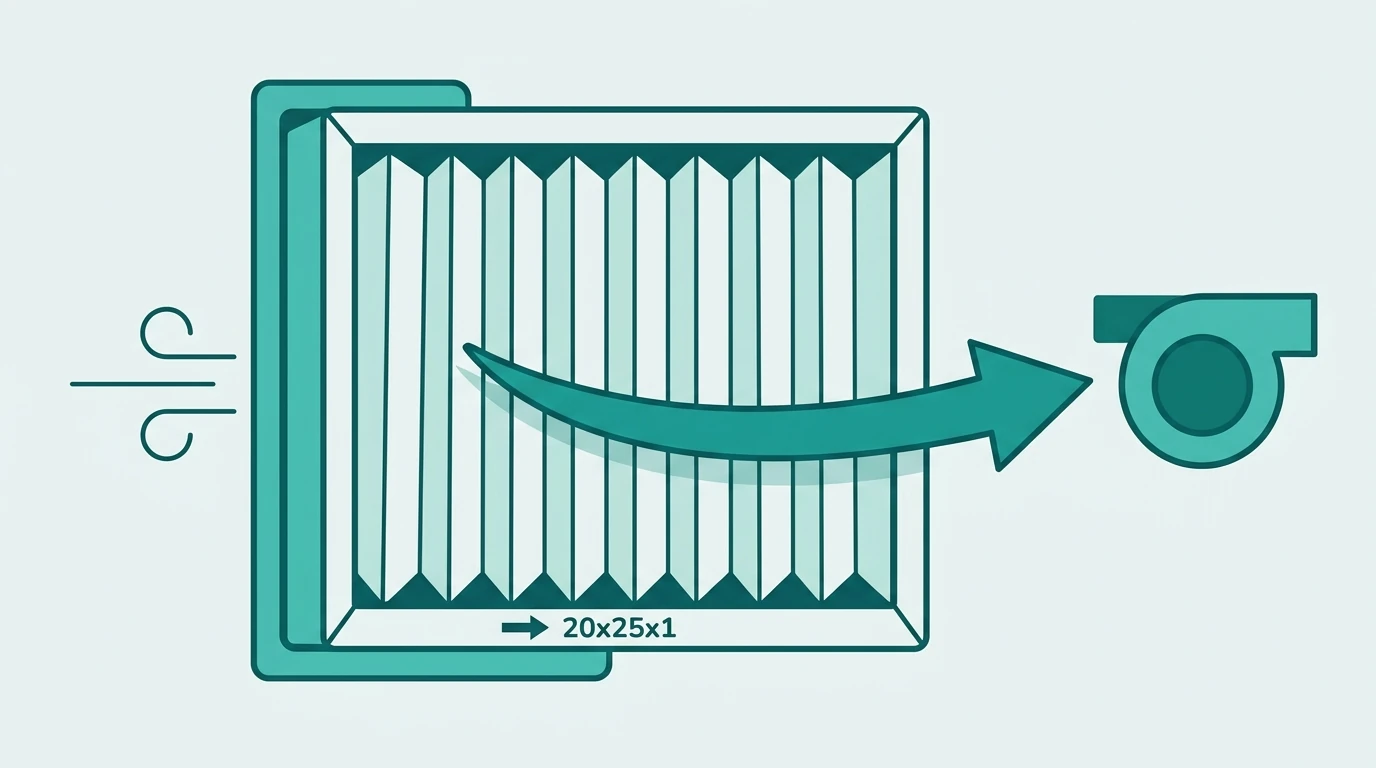
The arrow on a furnace filter points toward the furnace or blower motor, the way the air flows. Put it in backward and the system still runs, but it works harder than it should. Which way that arrow ends up facing depends on where your filter sits, so find your setup below and follow the instruction for it.
Find Your Setup First
The rule rarely causes the confusion. Not knowing which of these setups you have does. Match yours, then go to that section.
| Where your filter lives | What it means for direction |
|---|---|
| A grille in a wall, ceiling, or floor | See Return Grille Setups below. The arrow points away from the room |
| A slot on the furnace or air-handler cabinet itself | See Furnace or Air-Handler Cabinet Setups below |
| A 4-inch or 5-inch media cabinet bolted to the furnace | Same rule as a 1-inch cabinet filter: arrow toward the furnace |
| A washable or electrostatic filter | Same rule. These have printed arrows too |
| No arrow anywhere on the frame | See No Arrow on the Frame? below |
Return Grille Setups (Wall, Ceiling, or Floor)
If your filter sits behind a large grille in a wall, ceiling or floor, air is being pulled out of the room at that grille on its way back to the furnace. So the arrow points away from the room, into the ductwork behind it:
- Wall return: arrow points into the wall, away from the room.
- Ceiling return: arrow points upward, into the ductwork.
- Floor return: arrow points downward, into the ductwork below.
A filter in a ceiling return has gravity working against it. One that sat flush on install day can work loose or sag at one edge within a few months, so look at it between changes too, not only when you swap it.
Furnace or Air-Handler Cabinet Setups
If your filter slides into a slot on the furnace or air-handler itself, direction depends on which way your system moves air:
- Upflow furnace (common in basements and utility closets, air moves upward through the unit): arrow points up, into the unit.
- Downflow furnace (common in attics and upper-floor installations, air moves downward): arrow points down, into the unit.
- Horizontal furnace (common in attics, crawlspaces, and garages): arrow points sideways, toward the blower end of the unit.
All three follow the same rule, arrow toward the blower. Only the physical direction changes with how the unit is installed.
No Arrow on the Frame? How to Tell
Some filters, especially washable and electrostatic ones, have no printed arrow. You can still tell two ways:
- Check which side is denser. A pleated filter’s wire-mesh or reinforced backing faces the furnace side. The more open, pleated face is the side that takes the incoming return air.
- Feel for the pull. With the system running, hold a hand or a tissue near the open filter slot. The side pulling air toward it is the return side. Fit the filter with its open pleated face toward that pull and the reinforced side toward the furnace.
Both checks work with any of the setups above. Your setup tells you where the filter goes, and these tell you which way when there’s no arrow.
What Happens If You Install It Backward
Nothing fails right away, so it can go unnoticed for months. A backward filter restricts airflow more than it was designed to, and the blower works harder to move the same air. ENERGY STAR warns that a dirty filter can raise energy costs and damage the equipment, and a backward filter chokes airflow in a similar way. More dust also gets through than the rating on the box suggests, because the media isn’t loading the way it was built to.
If you find one in backward, flip it. That usually solves it. If it ran backward for a year or more and airflow still feels weak after the flip, have a technician look at the blower and coil.
Where Is the Furnace Filter Located?
If you haven’t found your filter yet, it’s almost always in one of three places:
- Behind a large return-air grille: a wall, ceiling or floor vent noticeably bigger than a supply vent, which you can feel pulling air in when the system runs.
- Inside the furnace or air-handler’s blower compartment: behind a removable panel or door on the unit, usually near the bottom on an upflow furnace or the top on a downflow one.
- In a dedicated filter rack or cabinet between the return duct and the air handler, common in homes with central air conditioning alongside the furnace.
Homes with more than one return-air grille often have more than one filter, so check every large grille in the house.
Need a replacement while you’re there? Read the size printed on the old filter’s frame first (our air filter size chart explains nominal vs actual size). For the four most common sizes:
16x25x1 · 14x20x1 at Air Filters Delivered · 20x25x1 · 16x20x1 at Factory Direct Filters. Other sizes: use the HVAC filter finder. (Affiliate links: we may earn a commission at no cost to you.)
Quick Reference: Mark It Once
Once you know the right direction, draw a small arrow on the cabinet or duct next to the filter slot with a permanent marker. It takes ten seconds, and nobody who changes the filter after you has to work it out again.
Frequently Asked Questions
Which way does the arrow go on a furnace filter?
Toward the furnace or blower motor, the same direction the air flows. Never back toward the room or return grille.
What if my furnace filter has no arrow?
Check which side has the wire mesh or reinforced backing (that side faces the furnace), or feel for suction at the open slot with the system running. The side pulling air is the return side.
Does the direction change for a horizontal furnace?
No. The arrow still points toward the blower. It just points sideways instead of up or down.
Where is my furnace filter located?
Most commonly behind a return-air grille (wall, ceiling, or floor), inside the furnace’s blower compartment behind a panel, or in a filter rack near an air handler. Some homes have more than one.
Related guides
Confirm you have the right size first → · Back to the HVAC filter finder →