Air Filter Size Chart: Furnace, HVAC & AC Filter Sizes (Nominal vs. Actual)
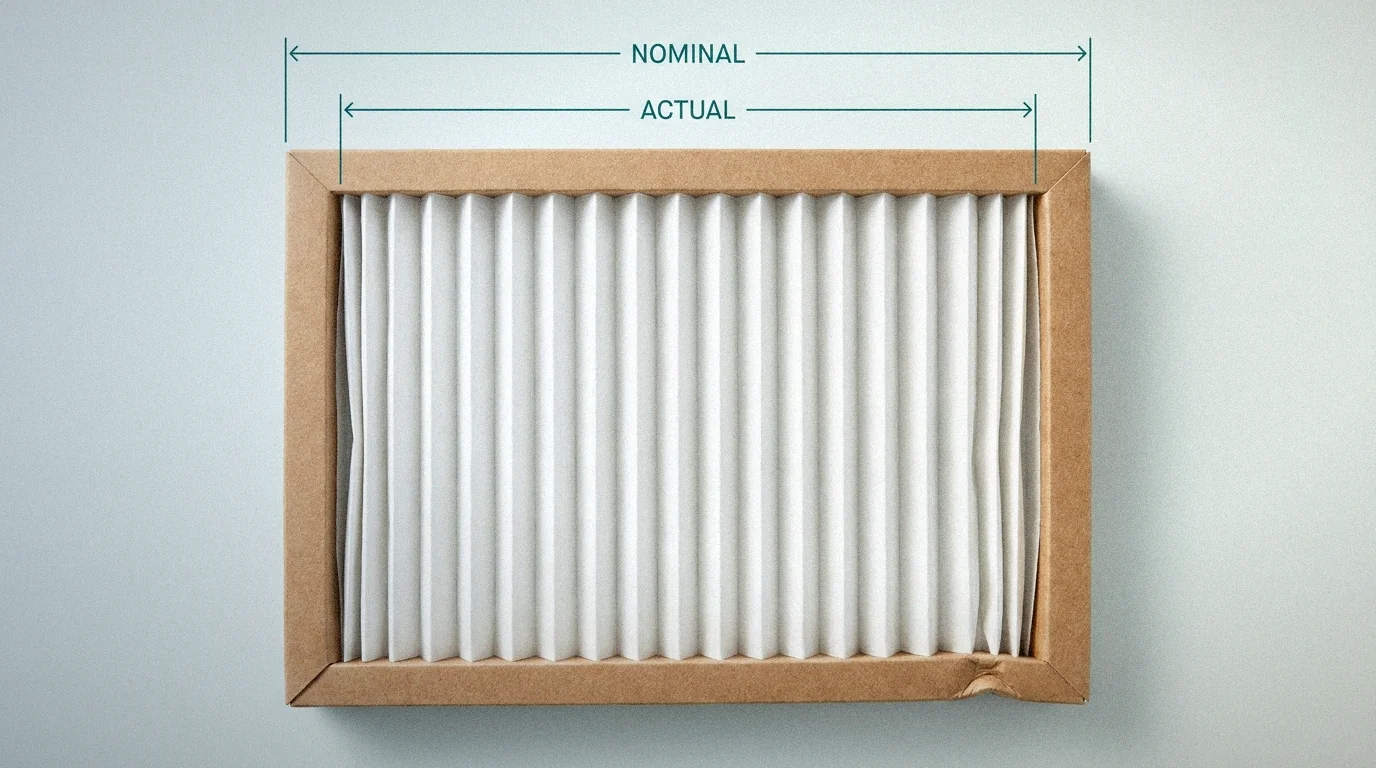
The size printed on your old air filter is almost never the size you’re actually holding. That’s not a manufacturing error — it’s intentional. Filters are sold under a rounded “nominal” size, but the real, physical dimensions are slightly smaller so the filter slides into your slot without binding. Mixing up the two is the single most common reason people order the wrong filter. This chart shows both numbers side by side, explains what MERV ratings actually mean, and helps you check your match against pricing from more than one retailer instead of just one store’s catalog.
These sizes apply whether you call it a furnace filter, an HVAC filter or an AC filter. Below you will find furnace filter sizes, HVAC filter sizes and AC filter sizes from 10x20x1 to 25x25x1 with their actual dimensions, plus common 2-, 4- and 5-inch options.
Nominal vs. Actual Size: What’s the Difference?
The nominal size is the rounded number printed on the filter frame and used in store listings — something like 20x25x1. The actual size is the real, measured dimension of the filter itself, which runs about ½ inch smaller in length and width so it fits inside the frame opening without forcing. A “20x25x1” filter, for example, actually measures closer to 19.5 x 24.5 x 0.75 inches. If you’re measuring your old filter with a tape measure instead of reading the printed label, you’re measuring the actual size — use the chart below to find the nominal size you need to order.
Air Filter Size Chart: 1-Inch Furnace, HVAC and AC Filter Sizes
The store links in the “Buy This Size” columns are affiliate links: we may earn a commission at no extra cost to you (disclosure). Both stores listed every linked size in stock on October 14, 2026. Always buy by the nominal size printed on your old filter.
| Nominal Size | Actual Size (approx.) | Notes | Buy This Size |
|---|---|---|---|
| 10 x 20 x 1 | 9.5 x 19.5 x 0.75 | — | Air Filters Delivered · Factory Direct |
| 12 x 12 x 1 | 11.5 x 11.5 x 0.75 | — | Air Filters Delivered · Factory Direct |
| 12 x 20 x 1 | 11.5 x 19.5 x 0.75 | — | Air Filters Delivered · Factory Direct |
| 12 x 24 x 1 | 11.5 x 23.5 x 0.75 | — | Air Filters Delivered · Factory Direct |
| 12 x 30 x 1 | 11.5 x 29.5 x 0.75 | — | Air Filters Delivered · Factory Direct |
| 14 x 14 x 1 | 13.5 x 13.5 x 0.75 | — | Air Filters Delivered · Factory Direct |
| 14 x 18 x 1 | 13.5 x 17.5 x 0.75 | — | Air Filters Delivered · Factory Direct |
| 14 x 20 x 1 | 13.5 x 19.5 x 0.75 | — | Find this size → |
| 14 x 24 x 1 | 13.5 x 23.5 x 0.75 | — | Air Filters Delivered · Factory Direct |
| 14 x 25 x 1 | 13.5 x 24.5 x 0.75 | — | Air Filters Delivered · Factory Direct |
| 14 x 30 x 1 | 13.5 x 29.5 x 0.75 | — | Air Filters Delivered · Factory Direct |
| 15 x 20 x 1 | 14.5 x 19.5 x 0.75 | — | Air Filters Delivered · Factory Direct |
| 16 x 16 x 1 | 15.5 x 15.5 x 0.75 | — | Air Filters Delivered · Factory Direct |
| 16 x 20 x 1 | 15.5 x 19.5 x 0.75 | One of the most common sizes | Find this size → |
| 16 x 24 x 1 | 15.5 x 23.5 x 0.75 | — | Air Filters Delivered · Factory Direct |
| 16 x 25 x 1 | 15.5 x 24.5 x 0.75 | One of the most common sizes | Find this size → |
| 16 x 30 x 1 | 15.5 x 29.5 x 0.75 | — | Air Filters Delivered · Factory Direct |
| 18 x 18 x 1 | 17.5 x 17.5 x 0.75 | — | Air Filters Delivered · Factory Direct |
| 18 x 20 x 1 | 17.5 x 19.5 x 0.75 | — | Air Filters Delivered · Factory Direct |
| 18 x 24 x 1 | 17.5 x 23.5 x 0.75 | — | Air Filters Delivered · Factory Direct |
| 18 x 30 x 1 | 17.5 x 29.5 x 0.75 | — | Air Filters Delivered · Factory Direct |
| 20 x 20 x 1 | 19.5 x 19.5 x 0.75 | One of the most common sizes | Air Filters Delivered · Factory Direct |
| 20 x 22 x 1 | 19.5 x 21.5 x 0.75 | — | Air Filters Delivered · Factory Direct |
| 20 x 24 x 1 | 19.5 x 23.5 x 0.75 | — | Air Filters Delivered · Factory Direct |
| 20 x 25 x 1 | 19.5 x 24.5 x 0.75 | One of the most common sizes | Find this size → |
| 20 x 30 x 1 | 19.5 x 29.5 x 0.75 | — | Air Filters Delivered · Factory Direct |
| 24 x 24 x 1 | 23.5 x 23.5 x 0.75 | — | Air Filters Delivered · Factory Direct |
| 24 x 30 x 1 | 23.5 x 29.5 x 0.75 | — | Air Filters Delivered · Factory Direct |
| 25 x 25 x 1 | 24.5 x 24.5 x 0.75 | — | Air Filters Delivered · Factory Direct |
Actual dimensions can vary by up to ⅛ inch between manufacturers — if your slot is a tight fit, measure the actual filter you’re removing rather than relying on the nominal number alone. “Find this size” links go to sizes our finder tool currently checks live pricing for; the rest are reference dimensions only.
Not sure which of these your system uses? Use our HVAC filter finder to check compatible sizes and MERV ratings, with pricing cross-checked across multiple retailers rather than just one store.
Are Furnace, AC and HVAC Filter Sizes the Same?
In a typical forced-air home, yes. The furnace and air conditioner share one blower, one duct system and one filter slot, so a furnace filter size, an AC filter size and an HVAC filter size are the same measurement (Filterbuy makes the same point). The exception is a home with more than one filter location, such as a return grille in a hallway plus a slot at the furnace. Each location has its own size, so check every one before you order.
2-Inch, 4-Inch and 5-Inch Air Filter Sizes
Thicker filters follow the same nominal-size rule, but the depth changes. These 2-inch sizes use an actual depth of 1.75 inches, as listed in Filterbuy’s published chart:
| Nominal Size | Actual Size (approx.) | Buy This Size |
|---|---|---|
| 14 x 20 x 2 | 13.5 x 19.5 x 1.75 | Air Filters Delivered · Factory Direct |
| 14 x 25 x 2 | 13.5 x 24.5 x 1.75 | Air Filters Delivered · Factory Direct |
| 16 x 20 x 2 | 15.5 x 19.5 x 1.75 | Air Filters Delivered · Factory Direct |
| 16 x 25 x 2 | 15.5 x 24.5 x 1.75 | Air Filters Delivered · Factory Direct |
| 20 x 20 x 2 | 19.5 x 19.5 x 1.75 | Air Filters Delivered · Factory Direct |
| 20 x 25 x 2 | 19.5 x 24.5 x 1.75 | Air Filters Delivered · Factory Direct |
| 20 x 30 x 2 | 19.5 x 29.5 x 1.75 | Air Filters Delivered · Factory Direct |
| 24 x 24 x 2 | 23.5 x 23.5 x 1.75 | Air Filters Delivered · Factory Direct |
The common 4- and 5-inch media filter sizes, also listed by Aerterra, are 16x20x4, 16x25x4, 20x20x4, 20x25x4, 16x25x5 and 20x25x5. We list nominal sizes only for these, because published actual depths differ: Filterbuy lists its 4-inch filters at 3.63 inches deep and its 5-inch filters at 4.75 inches, and other brands measure differently. Measure your filter cabinet before ordering a thick media filter.
What Do MERV Ratings Mean?
MERV (Minimum Efficiency Reporting Value) measures how well a filter captures particles, on a scale most commonly seen between 8 and 13 for residential use. It’s a separate spec from size — you need to get both right.
- MERV 8: Captures common household dust, pollen, and dust mite debris. The standard baseline for most residential systems and safe for nearly any HVAC unit.
- MERV 11: Adds capture of finer particles like pet dander and smaller allergens. A common step up for households with pets or allergy sensitivity.
- MERV 13: Captures fine particles including much of what’s in smoke and some bacteria-sized particles. The highest rating typically safe for standard residential blower motors — going higher usually requires a system built for it, since denser filter media restricts airflow more.
A higher MERV number isn’t automatically better for your system: a filter rated beyond what your blower motor is designed for can restrict airflow enough to strain the motor. Check your system’s manual, or use the finder tool above, which only shows MERV ratings confirmed to fit.
How Do You Measure Your Filter If You’re Not Sure?
Measure the length, width, and depth of your existing filter (or the empty slot) in inches, then round up to the nearest standard nominal size when ordering.
If you don’t have the printed size handy, measure the actual filter you’re removing:
- Remove the old filter and lay it flat.
- Measure length and width with a tape measure, to the nearest ⅛ inch.
- Measure the thickness (depth) — most residential filters are 1 inch, but 2, 4, and 5-inch depths exist on some systems.
- Round each measurement up to the nearest whole number for length and width — that rounded number is your nominal size for ordering. The chart above shows what actual size to expect for a given nominal number, so you can sanity-check your measurement against it.
Can You Use a Different Size Filter?
Use the exact nominal size your slot was built for. A filter that is even a little too small can let air bypass around the edges, and an oversized one can stress the blower motor, according to Aerterra. A 16x20x1 filter, for example, is five inches shorter than a 16x25x1, which leaves a gap unfiltered air can flow through. Depth matters too: a 1-inch filter does not belong in a slot made for a 4-inch media filter, or the reverse.
How Often to Replace Your Air Filter
Most standard 1-inch residential filters need replacing every 60–90 days, though homes with pets, allergy concerns, or heavy HVAC use often do better closer to the 60-day mark. Thicker 4- and 5-inch media filters, common on some higher-efficiency systems, can often go 6–12 months between changes — check your specific filter’s packaging, since replacement interval depends on media thickness and MERV rating, not just a fixed calendar schedule.
Filter is the right nominal size but still feels loose or does not fit right? See nominal vs. actual filter size explained →. Honeywell thermostat stuck on a filter reminder? See how to reset it by model →. Heat smells musty when it kicks on? See why, and when it is (and is not) normal →.
Frequently Asked Questions
Where is my furnace filter located?
Your furnace filter is in one of two places, depending on your system. On many furnaces it slides into a slot on the furnace unit itself, usually behind a small door or slide-out cover near where the large return air duct connects to the unit. On other systems it is mounted away from the furnace entirely, in a wall or ceiling return-air grille with a hinged or latched faceplate you can open by hand. If you are not sure which setup you have, check the furnace cabinet first, since that is the more common location. Once you have found it, check the size printed on the filter’s cardboard frame against the size chart above to confirm you are buying the right replacement, and note that the printed size is the nominal size rather than the filter’s true measurements.
What are standard air filter sizes?
The most common residential nominal sizes are 16x25x1, 20x25x1, and 16x20x1, though everything from 14x20x1 up to 20x30x1 and beyond is in regular production. Those numbers are nominal sizes, meaning the rounded figures printed on the frame and used in store listings rather than the filter’s true measurements. Actual dimensions run roughly half an inch smaller in length and width, and a nominal 1-inch depth is typically closer to 0.75 inches, which is deliberate so the filter slides into the slot without binding. When ordering, always use the nominal size. When measuring, remember you are reading actual dimensions and will need to round up to the nearest standard nominal size to find the right product. The chart above lists both figures side by side for the most common sizes, so you can work in either direction without doing the arithmetic yourself.
Is 20x20x1 a common air filter size?
Yes. 20x20x1 is a standard, widely stocked residential size, carried by every major filter retailer and easy to find in any MERV rating you are likely to want. Its actual measurements are approximately 19.5 by 19.5 by 0.75 inches, following the usual convention where the printed nominal size sits slightly above the true dimensions. That gap is normal and is what allows the filter to slide into the housing without forcing. Because it is a square size, it is also one of the few where orientation of length against width does not matter for fit, though the airflow direction arrow printed on the frame still does and should point toward the blower. If your slot measures close to 19.5 inches square, 20x20x1 is the nominal size to order. Its wide availability also means you are rarely forced to compromise on MERV rating to get the size you need.
How do I read an air filter size?
Air filter sizes are printed as length by width by depth, in that order, using the rounded nominal size rather than actual measured dimensions. A filter printed 16x25x1 physically measures closer to 15.5 by 24.5 by 0.75 inches. The nominal number is what you use when ordering a replacement, so the printed label on your existing filter is the single most reliable thing to buy from. Only measure if the label is missing or unreadable, and if you do, measure the slot opening rather than the old filter, since a used filter can be warped or compressed. Then round up to the nearest standard nominal size. Depth deserves particular attention because it is the dimension people overlook, and a filter of the wrong thickness usually will not fit the slot at all. Note the airflow arrow on the frame too, since a correctly sized filter installed backward still underperforms.
Which number is bigger — a filter marked “2” or one marked “4”?
That number is the filter’s depth, or thickness, in inches, not a quality tier or a size ranking. A 4-inch filter is physically thicker than a 2-inch one, and because greater depth means more filter media, it typically holds more and lasts longer between changes. What it does not tell you is filtration fineness, which is what the MERV rating describes; depth and MERV are independent specifications and a thicker filter is not automatically a finer one. The critical constraint is that depth has to match what your system’s filter slot was built for. A thicker filter will usually not physically fit a slot sized for a thinner one, and forcing one in defeats the seal and lets air bypass the media. Check your slot depth before upgrading, because a thicker filter is only an improvement if your system was designed to take one.
Are furnace filters and AC filters the same size?
In a typical forced-air home, yes. The furnace and air conditioner share one blower, one duct system and one filter slot, so the same filter and the same size serve both. If your home has more than one filter location, each location has its own size, so check every one.
Does a furnace filter have to be the exact size?
Yes. A filter that is too small can let air bypass around the edges, which reduces filtration, and one that is too large can stress the blower motor. Order the nominal size printed on your current filter, and only measure the slot if the label is missing.
Can I use a 16x20x1 filter instead of a 16x25x1?
No. A 16x20x1 filter is five inches shorter than a 16x25x1, so it leaves a gap where unfiltered air can pass around it. Buy the nominal size your slot was built for.
Related Filter Tools
Air filter sizing is only one part of keeping your home’s air and water systems running right. Check compatible matches for your specific equipment:
- HVAC Filter Finder — find your exact size and MERV rating, cross-checked across retailers
- Refrigerator Water Filter Finder — match your fridge model to a verified replacement filter
- Vacuum Filter Finder — find compatible filters for major vacuum brands
- Furnace Filters Guide — types, MERV ratings and sizing explained
- How Often to Change a Furnace Filter — by thickness and household
- Nominal vs. Actual Filter Size — why a filter that matches the label may not fit
- Water Filtration Guides — whole-house and under-sink filter sizing and cross-reference guides
Looking for a different filter?
Fridge Filters · HVAC Filters · Vacuum Filters · Water Filtration